Written by Business Moving Group - Southern California's Commercial Moving Experts.
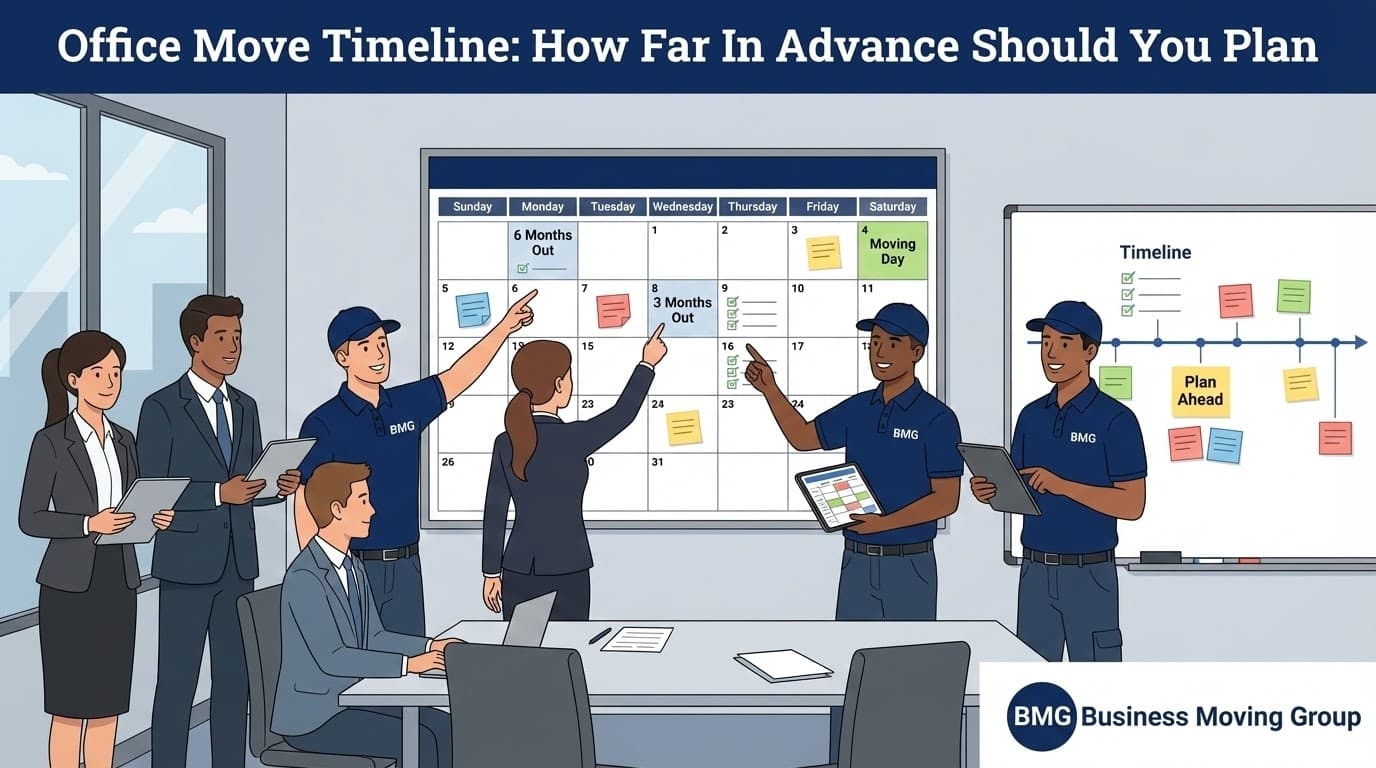
A commercial relocation is a rigorous exercise in project management. The most common question Facility Managers ask us is, "How much lead time do we need?" The operational standard is 90 days. While smaller teams might compress this, most businesses require a three-month runway to scope the logistics, secure building access, and execute the physical move without disrupting revenue streams.
At Business Moving Group, we operate on the philosophy of "Plan for 90 Days, Execute in 48 Hours". The goal is to confine the physical disruption to a single weekend, allowing your team to leave the old office on Friday and resume work at the new location on Monday. This guide breaks down the week-by-week protocol required to achieve that zero-downtime target.
Phase 1: Logistics & Scope (Weeks 12-9)
The first month is dedicated to defining the project parameters. Rushing this phase leads to scope creep and budget overruns later.
- Weeks 12-11 (The Audit): Assemble your internal Move Committee. Conduct a physical survey of both the origin and destination sites. Document critical logistics data: loading dock heights, freight elevator dimensions, and truck access restrictions.
- Week 10 (Vendor Selection): Secure your commercial moving partner. Request a Project-Based Do-Not-Exceed Quote rather than an open-ended hourly estimate. This ensures your budget is fixed.
- Week 9 (Compliance): This is critical in Southern California. Request the Certificate of Insurance (COI) requirements from both building management teams. Ensure your mover carries the necessary umbrella policies and "Additional Insured" endorsements.
Read more about COI requirements for office moves.
Phase 2: Technical Preparation (Weeks 8-5)
Once the logistics are set, the focus shifts to infrastructure and assets. This phase ensures that the new space is actually ready to receive your business.
- Week 8 (IT Cutover Strategy): Coordinate with your IT team to inventory all servers, racks, and workstations. Define the "Chain of Custody" for sensitive data. Schedule the ISP (Internet Service Provider) to have the circuit live at the new site well before move day.
- Week 7 (Space Mapping): Finalize the destination floor plan. Create a color-coded "Zone Map" (e.g., Accounting is Blue, Sales is Yellow). This map will dictate where every crate and piece of furniture is placed.
- Week 6 (Material Delivery): Order packing materials. We recommend plastic moving crates (eco-bins) over cardboard boxes for security and efficiency. Schedule crate delivery by department.
- Week 5 (Employee Communication): Distribute the move guide to staff. Clarify what personal items they must pack versus what the movers will handle.
Explore our IT and Technology relocation protocols.
Phase 3: The Sprint to Move Day (Weeks 4-1)
The final month is about execution and risk mitigation. This is where the 90-day plan ensures the 48-hour move is boring, predictable, and successful.
- Week 4 (Disposition): Decide what isn't moving. Arrange for the sustainable disposal, donation, or recycling of unwanted furniture. Do not pay to move items you will eventually throw away.
- Week 3 (Readiness Check): Confirm elevator reservations are locked in. Verify that building security has the names of all moving crew members for badge access. Walk the site to plan floor protection (Masonite) placement.
- Week 2 (Packing): Begin packing non-essential files and storage rooms. Label every crate on the side, not the top, so labels are visible when stacked.
- Week 1 (Final Prep): IT performs final backups. The "Smoke Test" plan is finalized (the checklist to verify systems are working at the new site). Empty breakroom fridges and clear common areas.
The 90 days of planning culminate in a 48-hour execution window, typically a weekend:
- Friday PM: Floor protection installed. IT disconnects workstations. Crews begin loading.
- Saturday: Transport and unload. Furniture installation. IT reconnection.
- Sunday: "Smoke Testing" networks. Fine-tuning furniture placement. Final clean-up.
- Monday AM: Business as usual.
Why Timelines Fail: Common Pitfalls
Even with a plan, external factors can cause delays. Being aware of these risks helps you mitigate them.
| Risk Factor | The Consequence | The BMG Solution |
|---|---|---|
| Elevator Conflicts | Trucks sitting idle; increased labor costs. | Book freight elevators 60 days out, confirmed in writing. |
| COI Rejection | Movers denied access to the building. | Submit COI samples to management 30 days prior for approval. |
| IT Failure | Monday morning downtime. | Pre-move "Tech Test" scheduled for Sunday afternoon. |
| Packing Delays | Employees packing while movers wait. | Strict "Pencils Down" deadline on Friday at 1:00 PM. |
Summary: The ROI of Preparation
A structured 90-day timeline is the difference between a chaotic disruption and a strategic transition. By breaking the move into logical phases-Logistics, Tech Prep, and Execution-you maintain control over your budget and your operations.
Ready to start your 90-day countdown? Partner with a team that understands the rhythm of Southern California business.