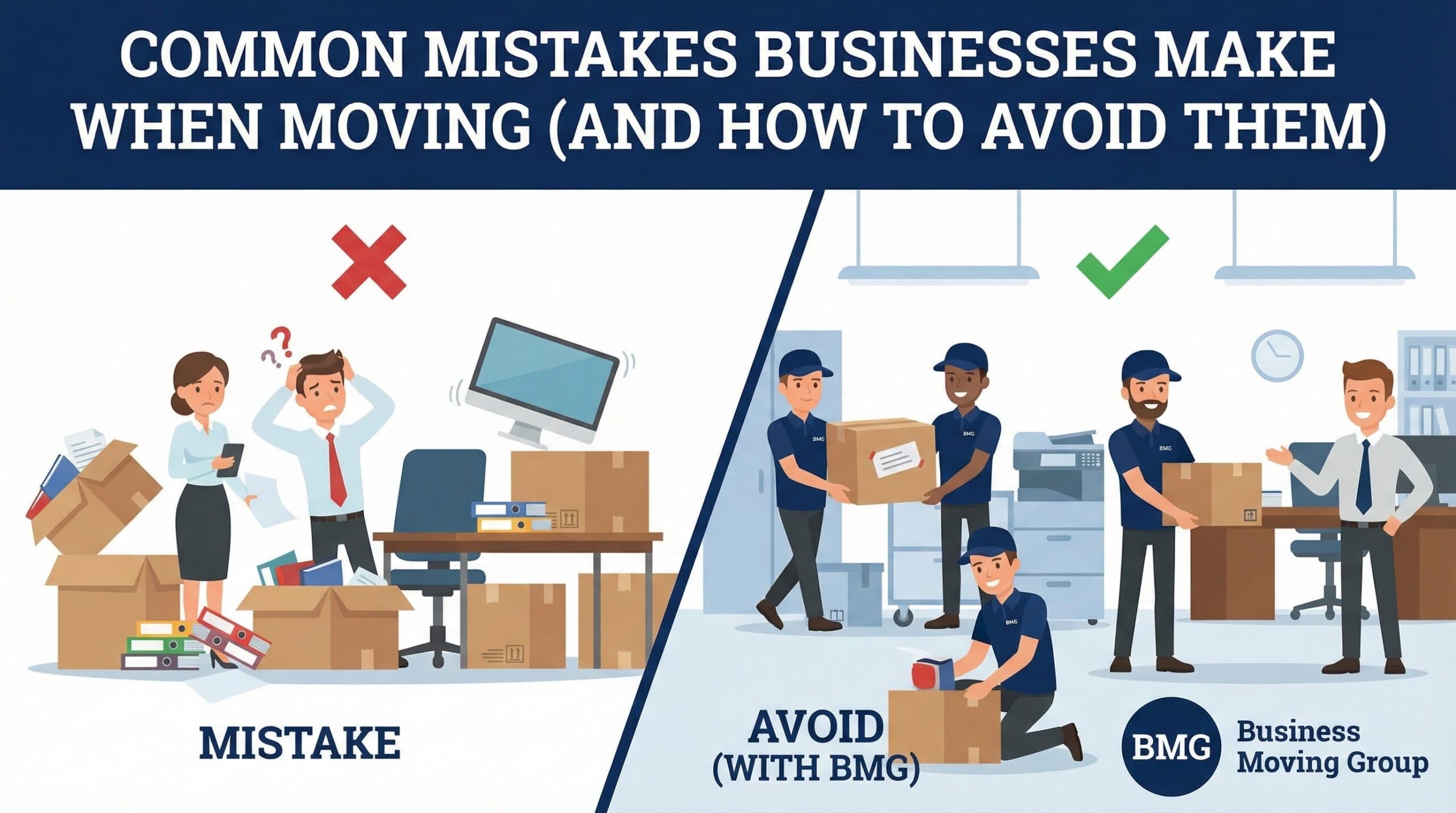
Common Mistakes Businesses Make When Moving (And How to Avoid Them)
[caption id="attachment_27067" align="aligncenter" width="2560"]
 Explore our commercial moving gallery to see the professional precision and diverse office relocation projects BMG has successfully delivered.[/caption]
Relocating your business is a major undertaking. Whether you're expanding, downsizing, or simply upgrading to a better location, moving an entire company comes with a long list of challenges. While the goal is a smooth transition with minimal disruption, many businesses run into costly, avoidable mistakes that slow down operations or inflate expenses.
At Business Moving Group, we've helped hundreds of companies across California and beyond relocate efficiently. In this guide, we break down the most common commercial moving mistakes-and how to avoid them.
- Underestimating the Scope of the Move
One of the biggest mistakes businesses make is assuming the move will be simpler or quicker than it actually is. Office relocations involve far more than just packing and transportation. There are IT systems to disconnect, floor plans to redesign, furniture to disassemble, and logistics to coordinate.
Avoid it by:
Creating a detailed move plan at least 6 to 8 weeks in advance. Include timelines, responsibilities, vendor coordination, and a full inventory of what's being moved.
- Not Getting a Proper Quote
Rushing into a move without a professional, detailed estimate is another common pitfall. Many companies rely on rough over-the-phone quotes or fail to ask what's included-leading to unexpected charges on move day.
Avoid it by:
Requesting an in-person or video walkthrough to receive an accurate, binding or not-to-exceed estimate. Make sure it includes labor, trucks, materials, disassembly, packing (if applicable), and any after-hours or elevator access fees.
3. Poor Communication With Staff
Failing to involve your employees early in the process can create confusion, stress, and productivity issues. From updated seating charts to what equipment stays or goes, employees need clarity to stay engaged and prepared.
Avoid it by:
Holding a meeting early in the planning stage to explain the move and assign team leads. Share timelines, move-day expectations, and how each department will be impacted.
4. Moving During Peak Business Hours
Some companies try to schedule moves during working hours, thinking it will be convenient. In reality, this creates safety risks, disrupts workflows, and slows down the entire process.
Avoid it by:
Planning your move after hours or over a weekend whenever possible. Business Moving Group offers flexible scheduling to minimize downtime and ensure a smooth transition.
5. Forgetting to Back Up Digital Systems
Relocation often involves moving servers, data cabling, and sensitive IT infrastructure. Overlooking data backups is a major risk that can lead to costly losses.
Avoid it by:
Backing up all critical data prior to disconnection. Coordinate with your IT team or an outsourced provider to secure files and ensure business continuity.
6. Not Labeling Items Properly
It's easy to assume movers will figure out where everything goes. But in reality, unlabeled boxes and furniture lead to chaos in the new space-wasting hours of productivity.
Avoid it by:
Color-coding by department and clearly labeling all items with destination room names. This streamlines unloading and allows each team to quickly set up.
7. Overlooking Building Requirements
Commercial buildings often have strict guidelines around moving, including elevator reservations, insurance certificates, and loading dock access. Skipping this step can delay your move or result in fines.
Avoid it by:
Contacting both your current and new building managers ahead of time. Ask about required documentation and reserve any needed access points in writing.
8. Trying to Do It All In-House
Some businesses try to save money by managing the entire move themselves, only to find it leads to mistakes, lost items, and longer downtime.
Avoid it by:
Partnering with a professional commercial moving company. Business Moving Group handles everything from planning to execution, ensuring nothing is overlooked and your team stays focused on work.
This is the official Federal Motor Carrier Safety Administration page, which offers credible and helpful information for commercial and residential moves - perfect for supporting advice on avoiding moving mistakes.
Summary Table: Common Mistakes and Solutions
| Mistake | Consequence | Prevention |
|---|---|---|
| No detailed plan | Delays, missed tasks | Create a move checklist and assign roles |
| Inaccurate quotes | Surprise fees | Request binding or not-to-exceed estimate |
| Poor staff communication | Confusion, low morale | Host a move kickoff meeting |
| Mid-day moving | Disrupts workflow | Move after hours or weekends |
| No IT backup | Data loss | Back up systems before move |
| No labeling | Misplaced equipment | Use clear labels by room/department |
| Ignoring building rules | Delays, fines | Contact building managers early |
| DIY move | Damage, delays | Hire experienced commercial movers |
Internal Relocation Responsibility Checklist
| Task | Who Should Handle It | Why It Matters |
|---|---|---|
| Inventory Audit | Office Manager or Admin | Ensures you only move what's needed and reduces moving costs |
| IT Equipment Backup | IT Department | Prevents data loss during disassembly and transport |
| Communicating With Staff | HR or Internal Communications | Keeps everyone informed and aligned on timelines |
| Vendor Coordination | Operations Manager | Helps avoid scheduling conflicts or delays with third-party vendors |
| Labeling & Packing | Department Heads or Assigned Teams | Minimizes confusion during unpacking and setup |
| Updating Business Addresses | Admin or Marketing | Ensures mail, packages, and client communications aren't lost |
| Walkthroughs With Movers | Facilities Manager or Project Lead | Confirms all logistics and special handling needs are understood |
Relocating doesn't have to be chaotic. With the right team, plan, and strategy, your business can transition smoothly without unnecessary stress or costs.
Ready to Simplify Your Business Move?
Contact Business Moving Group today for a free consultation!
Visit us at Business Moving Group for helpful resources and to learn more about our services.